
Household ID
Conviva is the leading streaming data platform, bringing publishers the insights they need for effective quality of service, marketing, and advertising analysis. The platform is built atop the Conviva Sensor, which is deployed on publisher video players with more than 3.3 billion instances worldwide and collects comprehensive, real-time cross-device data providing reliable and accurate information about video and ad performance for your entire streaming audience.
Insights Straight from the Video Player
Conviva helps solve the identity and measurement challenges with the industry’s most accurate streaming metadata collected directly from the video player, including classifying viewers/devices into households and assigning household IDs. Household identities along with extensive metadata and demographics empower a variety of use cases, driving innovative approaches to advertising and marketing business goals.
|
Objectives |
Business Goal |
|---|---|
| Advertising Media Planning |
• In response to an Advertiser's RFP for specific audience segments, quickly validate the viewership reach for the requested audience segment. • Proactively discover high-value, high-reach audience segments to help drive potential advertising opportunities. Understand the actual household reach of ad packages targeted to specific segments. |
|
Advertising Activation |
• Target ads more accurately to meet guaranteed audience and reach goals. • Avoid over-indexing and unnecessary increases in ad load. |
| Advertising Measurement |
• Accurately measure household reach and frequency of delivered ads to inform advertisers of the high-fidelity household reach and frequency of their delivered ads. • Identify ads that missed their target audience and adjust targeting to improve ad reach. Understand how well promo ads delivered against the targeted audience. |
|
Marketing Promotion Email & Social Marketing |
• Discover valuable audience segments that index with high reach on your platform. • Target promotional campaigns to the identified segments, which can lead to increases in new user acquisition and/or engagement. Target more accurately and increase efficiencies of ad inventory. |
Data Collection
Conviva collects the highest fidelity data from the Conviva sensor within the video player and sends the data to the Conviva backend for processing. Over 4 billion Conviva sensors have been deployed, collecting data on over 200 billion streams per year. Household IDs are created through the analysis of streaming behavior patterns aggregated across multiple apps and devices collected by the Conviva Sensor.
Metadata collected includes:
-
Content
-
Advertising
-
Engagement
-
Publisher audiences (segmentation)
-
Device
-
Location
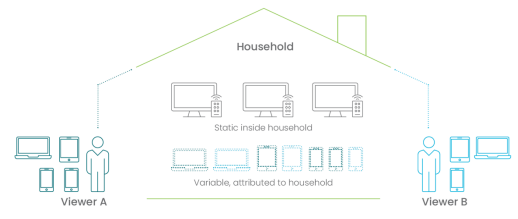
Household ID Built for Streaming Platforms
The Household ID links multiple devices to a single household based on anonymized publisher data that excludes cookies and mobile identifiers (mobile ad identifiers).
-
Maps multiple application downloads to one household
-
Generates Conviva Device ID (multiple apps-client ids identified as one device)
-
Mapping applications at the device level and devices to households helps to future proof publisher’s businesses. Conviva’s proprietary device ID removes reliance on device manufacturers to pass on device-level data.
Building the Household ID
-
App level metadata collection: Conviva sensor collects high-fidelity metadata from each video session from the video players; session level data is assigned to a Client ID, unique for every app download.
-
Clean the data: Identify IPs that can be matched to a residential household.
-
Detect primary residential IP for each client ID: For each client ID, Conviva reviews a defined historical period and identifies the primary residential IP.
-
Cluster client IDs into households: Conviva’s proprietary machine learning graph algorithms cluster client IDs based on the identified primary IP. The output of the model is a mapping of household IDs with a group of client IDs.
-
Cluster client IDs into devices: Conviva’s proprietary machine learning graph algorithms cluster client IDs based on the identified primary IP. The output of the model is a mapping of device IDs with a group of client IDs, which can be associated to households.
Standardized Data Collection
Household ID makes it easier for publishers to unify viewer identity across all their streaming points of distribution, including brands, applications, and devices. Standard data collection across all end points enables building viewer and household profiles across all points of distribution. Household ID is also ready to link to the larger ad ecosystem to enrich other data sources with a valuable, viewer-level experiential data set.
Persistent
Household ID is built upon a multi-ID framework, and works in cases of rotating or missing IDs including:
• Client IP Address
• Device Information
• Time Stamps
• Client ID
Continuous model improvement
Every stream is monitored and fed into the household model for continuous improvement. Conviva can detect when someone within a household watches content outside of a primary location, when a viewer moves out of a household, or when a whole household moves.
Daily updated
-
IP address changes (e.g., moving to a new home): The IP address-related feature in the predictive model is the ratio of shared IP addresses in the last 28 days. Even though the device IP address is changing, the IP shared device count will not change significantly.
-
Viewer migrations (e.g., kids move out to college): The IP address and ZIP code level location-related features are the most important in the model. When viewers move, their location and IP address change and the model will reassign the viewer’s household.
Conclusion
The Stream ID supports publishers in addressing streaming identity needs for marketing and advertising use cases, such as improving content recommendation, audience targeting, streaming measurement, and gaining deep audience insights.
| ID or Data Solution | What is it? | What’s the challenge for streaming? | How can Conviva Solve? |
|---|---|---|---|
| 3rd party cookies | Information tied to a user’s web browser that can be used across different websites. | Cookies face increased regulation, are web only and lack persistency. Cookies are associated with unwanted tracking. | Conviva’s Stream ID is based on publisher’s 1st party data and works on any platform. Stream ID persists, subject to the viewer’s preferences. |
| Device Ad IDs (IDFA, AAID, etc.) | Resettable identifier for ad use cases that persists on a device, typically used on phones and tablets. | Device makers are effectively deprecating these IDs by moving to an opt-in model for tracking. | Stream ID is not used directly for tracking or attribution. Stream ID is controlled by the publisher, not by a device manufacturer. |
| Registration-based IDs (Unified ID 2.0, ID5) | A persistent ID based on a user’s email address which otherwise behaves much like a cookie. Main use case is for programmatic demand. | Forces the choice between using publisher data based on household vs. using registration-based ID to get programmatic demand, ultimately serving buyers over publishers. Also risk of burner e-mails. |
Stream ID empowers the publisher to use the desired ID when and where appropriate. Stream ID is based on observed data rather than provided data, decoupling it from PII risk. |
| ID Graphs and data onboarders (LiveRamp, TapAd) | A map of a viewer identity across all platforms. | While mobile and web are well covered with many existing identity graphs, the lack of cookies on streaming devices has made them difficult to cover. | Conviva can complement existing cross device graphs by providing a high-quality streaming household graph. |
| Legacy DMP (Oracle, Adobe) | Data ecosystems designed to collect and transmit 1P segmentation data, or ingest and activate 3rdparty segments from a marketplace. | Dependent on cookies and MAIDs, not built for identity resolution. Pushing data to activation sources is a black box. |
Stream ID enables frictionless movement and analysis of a publishers 1P data across business platforms. Conviva data hub. |
| CDPs (Twilio, mParticle, Salesforce) | A holistic view of everything known about customers. | CDPs are missing quality data from streaming platforms. |
Stream ID is 100% focused on the streaming, making it a complement to other CDP vendors. |